You may have noticed I recently placed a Facebook link on the right-hand side of my Blog page…check it out…I only joined that “social utility” on July 27th 2008!
After my vacation I’ll be giving all my friends and fans an opportunity to be involved in another fascinating book I’m compiling…so think about joining Facebook and keeping up-to-date on my activities, and leaving yourself open to the possibility of being a part of one of my books!
I’ll explain more about that fun at a later date…after my R&R…Yippee!
Melanie Hack
Author of Who Killed My Sister, My friend
Read an excerpt now
TV Shows and Clips about the Death of Cindy James
This is the story of Jeannine, the daughter of a terminally ill father who dies while she is in the hospital giving birth.
Her family does not want to tell Jeannine the bad news while she is in labor so they decide to wait until she and the new baby are resting comfortably from their strenuous ordeal. The Mother then works up the nerve and tells her daughter that she has some bad new for her; that her dad had just passed on earlier that morning while she was in labor. Jeannine then smiles and tells her Mother that she, in fact, already knew and was ok with it. She said that her father was by the window outside the delivery room earlier and had told her that everything was going to go well with the delivery and that the baby and she would be fine. As he was terminally ill at that time she knew then that he had passed on and was using his last moments here to comfort her before he left. They both got to say goodbye and it made his passing much more bearable for all those he left behind.
Melanie Hack
Author of Who Killed My Sister, My friend
Read an excerpt now
TV Shows and Clips about the Death of Cindy James


Early on Aug 1, 2008, climbers were killed in an ice avalanche on the world’s second-largest peak, Pakistan’s K2 (an 8,611-meter or 28,253-foot mountain) after 22 climbers, in 8 different expeditions from around the world, had come together.
It is the deadliest incident at K2 since 1939.
Several people are still missing while two have been rescued (airlifted by helicopter this morning and sent to hospital for severe frostbite treatment), others are presumed on their way down on the China side and one (exhausted and frostbitten) is stranded at 7200m (and expected to be brought down tonight by four high-altitude porters).
Although the exact number of dead is confusing because of conflicting reports, Nazir Sabir, a celebrated Pakistani climber who scaled K2 in 1981 and was the recent Expeditions chief, said there are at least 11 mountaineers feared dead: 1 Norwegian, 1 Irishman, 2 Pakistanis, 1 Frenchman (the missing leader), 1 Serbian, 3 Korean, and 2 Nepalese citizens…one of whom plummeted off a 300-meter cliff.
That makes the number of deaths on the mountain somewhere in the 70’s (perhaps 77).
The climbers were coming down at dawn, in the dark, with little oxygen—a very, very dangerous situation in itself. When a fixed rope collapsed in the avalanche, three of the climbers fell to their deaths. Others climbers fell to their deaths in the mountain’s “bottleneck” area, or “dead zone”. (Two deaths had occurred during the ascent.) One of the rescued survivors said there were too many inexperienced and naïve climbers on the mountain.
Apparently the bodies may never be recovered. (Although the body of the Serbian climber was found near camp three and was buried by fellow climbers.)
For family members, time has stopped and days have little meaning—the anguished are living minute by minute, waiting for news…experiencing leaps of hope and logic as they wait for word on their loved ones who have yet to be removed…waiting for a body that may never be found.
Failure to recover a body or lay a loved one to rest properly can be very stressful for a family—sometimes grieving remains incomplete.
How do you grieve under those circumstances? Well, people need a focus for grief. That’s why memorials, monuments and/or burying a token artifact in a significant place can all help families deal with their memories when they don’t have a body to grieve over. People need a place to go—a place to grieve, a place to put flowers, a place to remember…
And please keep in mind, if you decide to attempt K2 you have maybe a 1 in 4 chance of dying up there—there’s a 27% fatality rate.
Melanie Hack
Author of Who Killed My Sister, My friend
Read an excerpt now
TV Shows and Clips about the Death of Cindy James
A grieving mother shared the following:
“One thing I wanted to talk to you about is things people say when a loved one dies. I know people are well meaning and I am sure I have said things when consoling others that now I find abhorrent.
“The worst was and still is, ‘She is in a better place.’
“One couple that has an only child – a daughter with special needs like ours – said to me that ——– was better off and that I no longer had to worry about her future. I had to walk away from them before I hit them. I know what they meant though and they meant their words to be comforting and I felt so guilty afterwards for being so harsh on them. You worry so much about a child with special needs and what will happen to them as they and you get older. They are easy targets for being taken advantage of – particularly girls – and you worry about what will happen when you are no longer able to look after them. My children always said they would look after ——– – always be there for her – always have a home for her – but that is them and maybe their future spouses or ways of life would not allow them to care for her. What then – you don’t want siblings to jeopardize their happiness or future as well meaning as they want to be – and perhaps it could work out just fine.
“I remember another mum saying she occasionally thought when she could no longer care for her daughter that she would do a murder/suicide. She could not bear the thought of her daughter being alone without her, not knowing who and how and if she would be loved and cared for, nor the pain and anxiety she was sure her daughter would suffer if her mother and only caregiver died – her father had died when she was a child. Would her child understand death or would she think her mother had deserted her – real concerns with children of special need. I can totally understand that way of thinking but I sure didn’t need to hear it when ——– died.
“It made me wonder if ——— thought I had let her die so I would not have to worry about her anymore – how irrational is that.
“Anyhow if nothing else it has made me aware of how words said in comfort and consolation can sometimes be misinterpreted and hurtful to a person who is grieving. The times I have had to offer consolation to others since ——– died I now merely say, ‘My condolences.’ … ‘I am so sad for you and your family.’ … ‘If there is anything I can do.’ … Or just merely a hug expresses it all.
“Words, no matter how well intentioned, can be hurtful and more so when you are grieving and not thinking straight.”
Melanie Hack
Author of Who Killed My Sister, My friend
Read an excerpt now
TV Shows and Clips about the Death of Cindy James
When I was walking out of the bank I overheard a woman say to a friend, “Well, these things happen you know” in reference to that friend’s loved one recently dying of a heart attack (with horrific circumstances I might add…the car flipped off the road and exploded…we all heard the sirens when the accident happened…).
I think I visibly cringed at the words I heard from that woman.
I’m sure she meant well, but that was NOT the thing to say to someone who has experienced the death of a beloved. Her words rank up there with the following WORST things you could say:
“Death was a blessing.” (I know you probably mean the person is no longer suffering, and that can be a relief for some, but a mourner never feels the death of a beloved is a blessing—to have someone yanked out of your life is always painful. And, as one mourner said, “She was uncomfortable but was not suffering and we were looking after her – we were with her constantly – we would never have let her suffer.)
“It all happened for the best.”
“It was God’s will.” Or “God, needed her. He took her for a reason.” (Well then God needs to explain that to a mourner because, as one mourner said, “we needed her here and if God took her for His own needs He certainly left a lot of broken people behind.”)
“She’s in a better place.” (As one mourner, who had heard those painful words from someone, told me, “Well, we thought she was in a good place here with us!)
“You’ll feel worse before you’ll feel better.” (Instead just say, “You must really be hurting!”)
“You have your whole life ahead of you.” (Instead say, “Take all the time you need.”)
Other painful phrases NOT to say:
“Something good will come out of this.”
“You can always remarry.”
“It’s time to put it behind you now.”
Then there is the reference to “losing” the person – our “loss” (when you say, “I’m sorry for your loss.”) When one mourner heard that she wanted to scream, “WE did NOT lose her – she died!”
The stress and anxiety of an encounter with a grieving person can sometimes make it difficult to know what is helpful to say…but please realize a phrase that may be meant to help can actually produce distress.
In another Blog post I’ll share what one grieving mother had to say about words.
Melanie Hack
Author of Who Killed My Sister, My friend
Read an excerpt now
TV Shows and Clips about the Death of Cindy James

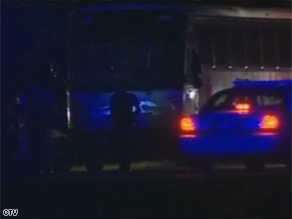
I just heard about a horrific murder…here in Canada…and it happened two days ago at 8:45pm on Wednesday night (July 30/08). As I read the news wire, the story got more and more bizarre…and I kept thinking, “I know a fellow who would be about the same age as the victim (18 or 19), also from Edmonton … oh, please let him be OK …”
A 40-year-old man wearing sunglasses and brandishing a Rambo-type knife (a hunting knife, I guess), stabbed the young man (who was wearing earphones and seated…well, sleeping with his head against the window…beside the guy on a greyhound bus headed to Winnipeg) 40 or 50 times, beheaded him and gutted him and taunted police with the head by sticking it out a window—a three-hour standoff. That’s just sick! It is absolutely revolting…and terrifying…and makes me want to puke!
I’ve never heard of anything like this happening before…a stabbing and a beating, yes…but not THIS!
At this point nobody knows why it happened, but I read that the attacker showed no emotion, no rage, no swearing, but was calm and robot-like.
I feel for the family of the victim, the passengers on the bus, the driver, and everyone who had to respond to the situation. This is certainly a circumstance that screams for trauma counseling…how to cope…how to reduce the profound effect this experience will have…there were children on board who saw what was happening…some passengers said they have been unable to sleep or eat since it happened…such haunting images and flashbacks to have to deal with!
Some will be in shock, others immobilized, and others will experience uncontrollable crying.
It has to be stressed to the children that it’s over and they are safe.
But can passengers ever really feel safe on a bus again? I have to wonder why such a weapon was even allowed on the bus in the first place!
Melanie Hack
Author of Who Killed My Sister, My friend
Read an excerpt now
TV Shows and Clips about the Death of Cindy James
“Watching a peaceful death of a human being reminds us of a falling star; one of a million lights in a vast sky that flares up for a brief moment only to disappear into the endless night forever.”
~ Dr. Elisabeth Kubler-Ross
Melanie Hack
Author of Who Killed My Sister, My friend
Read an excerpt now
TV Shows and Clips about the Death of Cindy James
Some dying people show increased anxiety and fear as death draws nearer.
Sometimes this is an indication that something unresolved, unfinished, or unreconciled, over some important issue or with some significant relationship, is disturbing them…and preventing them from letting go.
And sometimes it is an indication that the person is ready to say good-bye but is testing you to see if you are ready to let that person go.
It can be hard to pinpoint exactly what could be happening with your beloved as you watch her/him perform repetitive and restless tasks or hear them make a seemingly out of character or non sequitur statement (a thought that does not logically follow what has just been said), gesture, or request. But there are ways to help the person find release from the tension or fear. Here are some things that may be helpful in calming the person:
Recall aloud a favorite place the person enjoyed, or a favorite experience they had—favorite memories, places, and activities you shared.
Read something comforting to them.
Ask them if there is someone special they wish to speak with.
Play their favorite music.
Ask gentle questions about what they are seeing or feeling but respect their right to say nothing—be aware when they want to remain in silence, but let them know you are still listening.
And accept the moment of letting go as a beautiful gift when it is offered.
A dying person will normally try to hold on, even though it brings prolonged discomfort, in order to be sure those who are going to be left behind will be all right. So release the dying person from this concern—give him/her assurance that it is all right to let go whenever s/he is ready—acknowledge the difficulty of letting go. Yes, giving permission to your loved one to let go, without making him/her guilty for leaving or trying to keep him/her with you to meet your own needs, can be difficult. But it is one of the greatest gifts you have to give your loved one at this time.
When the person is ready to die and you are able to let go, then is the time to say good-bye. Saying good-bye is your final gift of love to your loved one, for it achieves closure and makes the final release possible.
Tears are a normal and natural part of saying good-bye. Tears do not need to be hidden from your loved one or apologized for. Tears express your love and help you to let go.
So kiss…hug…lie in bed and hold the person…cry…take his/her hand…and say whatever you most need to say—everything you need to say…
“I love you.”
“I’m sorry for whatever I contributed to any tension or difficulties in our relationship.”
“Thank you for…”
Melanie Hack
Author of Who Killed My Sister, My friend
Read an excerpt now
TV Shows and Clips about the Death of Cindy James
If you haven’t seen this last lecture, by Randy Pausch, take 10 minutes and watch it now…your life won’t be the same!
A Professor in London has been investigating the phenomenon of visits from deceased loved ones or visions of a heavenly realm and he has now been able to build up a tentative picture of what he believes happens in the hours before death…
He says that often the first thing those close to death experience is the realization that there are friendly spirits in the room, who arrive with the express purpose of carrying them to another realm. As the patient becomes more aware of their presence, fear turns to happiness and eventually bliss.
These spirits will often sit for hours comforting the dying person as their body progressively shuts down and dies.
As part of this process, the spirits precipitate a review of your life – including all of its failings – that enables a dying patient to resolve any lingering conflicts with friends and loved ones.
It would appear that when this process is complete, then death quickly follows.
Melanie Hack
Author of Who Killed My Sister, My friend
Read an excerpt now
TV Shows and Clips about the Death of Cindy James